
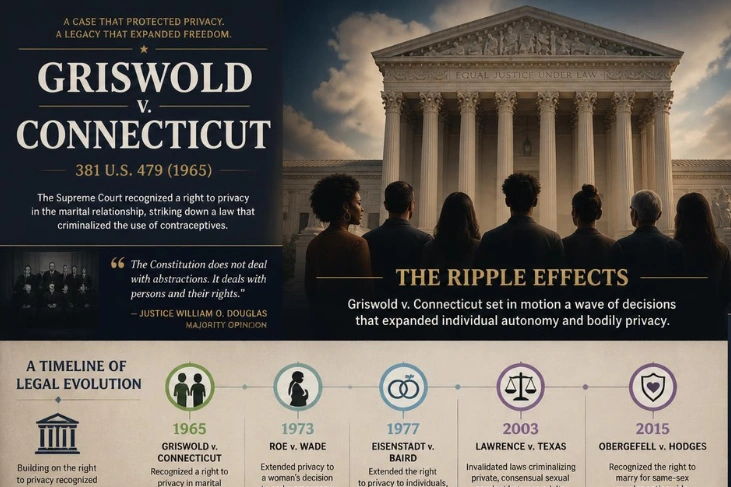





The impact of Griswold v. Connecticut went far beyond a dispute over a state birth-control law. What Was the Impact of the Griswold v. Connecticut? The U.S. Supreme Court’s 1965 decision protected married couples from government interference with their use of contraception and recognized constitutional protection for marital privacy. Over the following decades, the ruling’s reasoning influenced major decisions involving reproductive choice, private relationships, and personal autonomy.
Quick answer
The ruling struck down Connecticut’s ban on contraceptive use by married couples and recognized constitutional protection for marital privacy. Its impact went further by providing a foundation for later decisions involving contraception for unmarried people, reproductive autonomy, private consensual relationships, and marriage rights, while reshaping debates over unenumerated constitutional liberties.
Key takeaways
- Griswold v. Connecticut invalidated a state law prohibiting married couples from using contraception.
- The decision recognized a constitutionally protected sphere of marital privacy.
- Eisenstadt v. Baird later extended contraception protections to unmarried people.
- The case influenced later rulings involving abortion, intimate relationships, and marriage.
- Griswold remains precedent after Dobbs v. Jackson Women’s Health Organization, although its constitutional reasoning remains part of an ongoing legal debate.
What Happened in Griswold v. Connecticut? — What Was the Impact of Griswold v. Connecticut?
Connecticut had a law making it a crime to use a drug or device for the purpose of preventing conception, along with a law punishing people who assisted or counseled others in violating that prohibition. Estelle Griswold, executive director of the Planned Parenthood League of Connecticut, and physician C. Lee Buxton operated a clinic that advised married couples about contraception. They were arrested, convicted as accessories, and fined before challenging the law in the U.S. Supreme Court. What Was the Impact of Griswold v. Connecticut? The case established constitutional protection for married couples’ access to contraception and became an important foundation for later privacy-related decisions.
On June 7, 1965, the Supreme Court ruled 7-2 against Connecticut and reversed the convictions. Cornell’s Legal Information Institute publishes the full text of that 1965 decision as Griswold v. Connecticut, 381 U.S. 479. Justice William O. Douglas’s majority opinion reasoned that guarantees contained in several parts of the Bill of Rights create protected “zones of privacy,” making the government’s intrusion into the marital relationship unconstitutional. Other justices agreed with the result but offered different constitutional reasoning, including arguments based on the Ninth Amendment and the Fourteenth Amendment’s protection of liberty.
What Was the Impact of the Griswold v. Connecticut Ruling?

The decision immediately struck down Connecticut’s contraception ban, but its legal importance grew much broader over time. Subsequent Supreme Court cases developed principles of individual autonomy and liberty that drew on Griswold even when the later disputes were not about married couples or birth control. That makes the ruling an important starting point for understanding modern constitutional debates about how far government may intrude into intimate personal decisions. Readers who want more background on how American courts work can browse WatchingHub’s plain-English Law section alongside this case.
| Major impact | Why it mattered |
| Protected contraceptive use in marriage | States could not criminalize married couples’ use of contraception in the manner Connecticut had done. |
| Strengthened constitutional privacy doctrine | The Court recognized protection for intimate decisions even though the word “privacy” does not expressly appear as a general right in the Constitution. |
| Helped extend contraception rights | Later cases protected unmarried people and placed greater emphasis on individual choice. |
| Influenced later liberty cases | Griswold became part of the doctrinal history behind cases involving reproductive decisions, consensual intimacy, and marriage. |
| Changed constitutional interpretation debates | The case became a major example in disagreements over unenumerated rights and the judiciary’s role in defining protected liberty. |
1. It Protected Married Couples’ Ability to Use Contraception
The most direct impact was the invalidation of Connecticut’s attempt to criminalize contraceptive use by married couples. The Court viewed the law as an extraordinary intrusion into the marriage relationship, particularly because enforcement could reach deeply into the privacy of the home and intimate family decisions. The ruling therefore placed a constitutional limit on how aggressively a state could regulate married couples’ decisions about preventing pregnancy.
That protection also changed the relationship between government regulation and reproductive decision-making. Instead of treating contraception as a subject entirely within state police power, the Court identified an area in which personal and marital interests deserved constitutional protection. Later cases built on that principle and moved the doctrine beyond the marital relationship itself.
2. It Gave Constitutional Privacy a Powerful New Role
One of the ruling’s most lasting effects was treating privacy as a constitutional right even without a single clause that explicitly declares a general right to privacy. Justice Douglas explained that guarantees in the First, Third, Fourth, Fifth, and Ninth Amendments help create zones in which individuals are protected from certain forms of government intrusion. The majority applied that concept specifically to the intimate relationship of marriage.
The exact constitutional foundation of privacy did not remain limited to Douglas’s “penumbras” analysis. Justice John Marshall Harlan II emphasized Fourteenth Amendment liberty, an approach that became especially important in later substantive due process cases. As a result, Griswold mattered not only because of the right it protected, but also because it helped advance a broader constitutional conversation about liberties that are fundamental even when they are not listed word-for-word in the Constitution.
3. Its Protection Expanded Beyond Married Couples
Seven years later, the Supreme Court decided Eisenstadt v. Baird, which involved a Massachusetts law restricting access to contraception for unmarried people. The Court concluded that the state could not constitutionally treat married and unmarried people differently in that way. Its reasoning emphasized that decisions about whether to bear or beget a child ultimately belong to the individual, not to marriage as an institution.
That development significantly expanded Griswold’s practical legacy. Privacy relating to contraception was no longer understood only as protection surrounding a married couple, because individual autonomy became increasingly central to the doctrine. In Carey v. Population Services International (1977, the Court further recognized constitutional protection for choices concerning contraception while reviewing restrictions on its distribution.
4. It Influenced Reproductive-Rights Doctrine
Griswold also became part of the constitutional foundation used in later reproductive-rights litigation. When the Supreme Court decided Roe v. Wade in 1973, its analysis drew from a line of privacy and liberty decisions involving marriage, procreation, contraception, family relationships, and childrearing. For decades, Griswold therefore occupied an important place in the development of the doctrine surrounding reproductive autonomy.
The legal landscape changed substantially in 2022 when Dobbs v. Jackson Women’s Health Organization overruled Roe and Planned Parenthood v. Casey. The Dobbs majority stated that its decision concerned abortion and should not be understood as casting doubt on precedents that do not involve abortion. Justice Clarence Thomas separately argued that the Court should reconsider substantive due process cases including Griswold. The distinction matters because Dobbs eliminated the federal constitutional abortion right recognized in Roe, but it did not overrule Griswold.
5. Its Influence Reached Cases About Intimacy and Marriage
The privacy and liberty principles associated with Griswold later appeared in cases outside contraception. In Lawrence v. Texas in 2003, the Supreme Court struck down a Texas law criminalizing certain private consensual sexual conduct between adults and discussed Griswold as an important point in the development of constitutional protection for intimate choices. The Court explained that subsequent decisions after Griswold and Eisenstadt reinforced the protection of marital privacy.
Obergefell v. Hodges, the 2015 decision recognizing a constitutional right of same-sex couples to marry, also cited Griswold when discussing choices central to individual dignity and autonomy. The Court specifically referred to Griswold, emphasizing the importance of intimate association within marriage and the broader protection of personal choices under the Fourteenth Amendment. This does not mean Griswold alone produced those later holdings, but it became an important precedent in the constitutional line from which they developed.
Why Was the Griswold Decision Controversial?
The controversy surrounding Griswold has always involved more than contraception itself. Critics have argued that judges should not recognize constitutional rights unless those rights have a sufficiently clear foundation in constitutional text, history, or established legal tradition. Justices Hugo Black and Potter Stewart dissented in Griswold, objecting to the constitutional reasoning even though the Connecticut law itself could be viewed as unwise or objectionable.
Supporters of the decision take a different view of constitutional liberty. They argue that constitutional guarantees can protect fundamental personal choices even when the Constitution does not list every protected activity by name, just as broader principles have been applied to circumstances the framers could not have specifically described. The continuing disagreement over those methods of interpretation helps explain why Griswold remains important in debates about substantive due process and unenumerated rights.
What Griswold Did, and Did Not, Decide
It is easy to describe Griswold too broadly, because the case did not establish an unlimited right to do anything a person considers private. The immediate holding concerned Connecticut’s prohibition on contraceptive use as applied to married couples and the intrusion that prohibition created within the marital relationship. The Court did not declare that every government regulation governing contraception, medicine, sexuality, or family life was automatically unconstitutional.
Later Supreme Court cases determined how far the underlying principles would reach. Eisenstadt addressed unmarried people, Carey examined restrictions on contraceptive distribution, and later decisions applied liberty principles to other intimate decisions. Understanding those separate steps avoids giving Griswold credit for holdings the Supreme Court actually reached only years or decades later.
Does Griswold v. Connecticut Still Matter Today?
Yes, Griswold v. Connecticut continues to matter in U.S. constitutional law. The Supreme Court has not overruled the decision, and later opinions have repeatedly discussed it as part of the constitutional history of contraception, marriage, privacy, and individual autonomy. Even Dobbs, while transforming abortion law, expressly distinguished abortion from precedents involving other issues rather than overturning Griswold.
The case also remains important because debates over its reasoning have never completely disappeared. Some jurists and legal scholars defend substantive constitutional protection for intimate personal choices. In contrast, others argue for a narrower approach to unenumerated rights grounded more in constitutional text and historical tradition. Griswold therefore matters both as an existing contraception precedent and as a central example in the continuing debate over how American courts identify fundamental liberty.
Readers exploring other U.S. legal topics may find WatchingHub’s guide to what hearsay means in court a useful companion, because it shows how another major area of American law works in practice. That explainer provides broader legal context while keeping the constitutional questions involved in Griswold separate.
Final Takeaway
The lasting impact of Griswold v. Connecticut was not simply that one state lost the power to enforce an old contraception ban. The ruling established strong constitutional protection for marital privacy and helped create a path toward broader protections for individual decisions involving contraception, intimacy, reproduction, and marriage. More than six decades later, it remains both an operative Supreme Court precedent and a central case in the national debate over the meaning of liberty under the U.S. Constitution.
Frequently Asked Questions
What was the immediate impact of Griswold v. Connecticut?
The immediate impact was that Connecticut could no longer enforce its prohibition on contraceptive use against married couples in the manner challenged in the case. The Supreme Court reversed Griswold and Buxton’s convictions and held that the statute violated constitutionally protected marital privacy. Later courts expanded the Court’s reasoning by applying related privacy and liberty principles to additional situations.
Did Griswold legalize birth control for everyone in the United States?
Not by itself. Griswold specifically concerned contraceptive use by married couples, so protection for unmarried people developed later through Eisenstadt v. Baird in 1972. Subsequent decisions such as Carey further shaped constitutional limits on government restrictions affecting contraception.
Did Griswold create the constitutional right to privacy? More precisely,
More precisely, Griswold recognized constitutional protection for marital privacy by drawing on several constitutional guarantees. Earlier cases had already dealt with privacy-related interests, but Griswold became one of the Supreme Court’s most important modern privacy decisions. Later cases often developed these protections through the Fourteenth Amendment’s concept of liberty rather than relying only on the majority opinion’s “penumbras” reasoning.
Did Dobbs overturn Griswold v. Connecticut?
No. Dobbs v. Jackson Women’s Health Organization overturned Roe v. Wade and Planned Parenthood v. Casey, not Griswold. The majority stated that its abortion holding should not be understood to cast doubt on precedents unrelated to abortion. However, Justice Thomas separately called for reconsideration of Griswold and other substantive due process cases.