
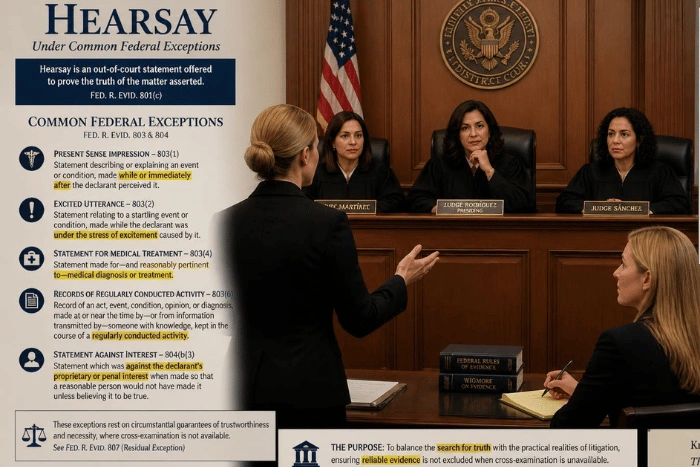





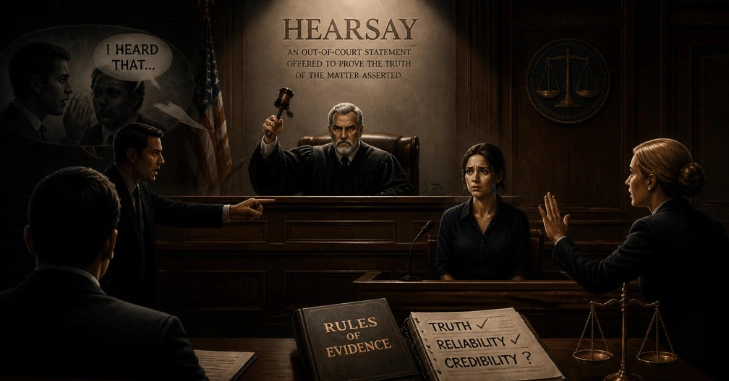
Hearsay is a statement made outside the current trial or hearing that a party offers to prove the truth of what the statement says. Under the U.S. Federal Rules of Evidence, that type of statement is generally excluded unless a statute, another evidence rule, or a recognized exception allows it.
The key question is not simply who said something or where it was said. The purpose for offering the statement matters. The same words may be excluded for one purpose but allowed for another. Federal rules govern federal proceedings, while state evidence rules can differ.
| Key point | Plain-English explanation |
| Basic test | Was there a statement made outside the current proceeding, and is it offered to prove what it asserts? |
| General federal rule | Such statements are generally excluded unless another rule, federal statute, or Supreme Court rule permits them. |
| Main federal provisions | Rules 801 through 807 address definitions, exclusions, exceptions, and related issues. |
| Important distinction | Some statements fall outside the definition, while others qualify for an exception. |
| Practical caution | Admissibility depends on the statement, its purpose, its foundation, and the rules that apply in that court. |
Why Hearsay Is Usually Excluded in Court
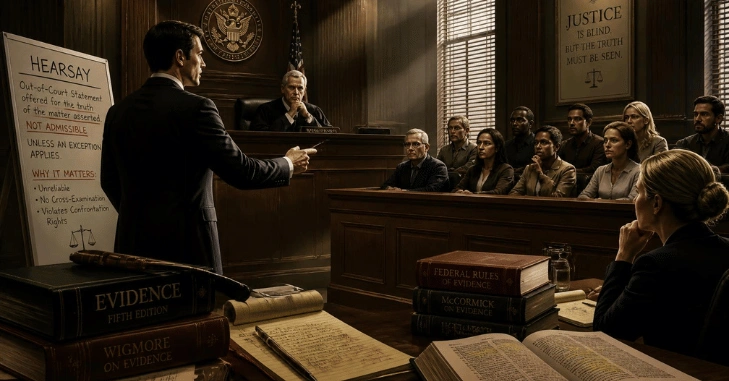
Evidence is stronger when the person who made the claim can testify under oath and be questioned. An out-of-court speaker may not be present for the opposing side to test the person’s memory, perception, wording, or credibility. Rule 802 therefore establishes a general rule against admitting these statements unless another legal basis applies.
That concern becomes especially important when witnesses disagree about what happened. WatchingHub’s guide to how an assault lawyer handles witnesses and evidence offers related information on how testimony may be challenged in a case.
The Three-Part Test: Does the Rule Apply?
Rule 801 provides a useful way to analyze a statement.
- Is there a statement? This can include an oral assertion, a written assertion, or conduct intended as an assertion.
- Was it made outside the current trial or hearing? A statement made earlier can satisfy this part of the test.
- Is it offered to prove the truth of what it says? If so, the general exclusion rule may apply unless another provision allows it.
The third question often determines the outcome. Suppose a store received repeated customer complaints about a broken stair. Those complaints might be offered to show that the store had notice of a possible problem.
In that situation, the point may be that the warning was received, not that every detail in each complaint was true. Rule 801 focuses on whether a statement is offered to prove the truth of the matter asserted.
Five Examples That Show How the Rule Works
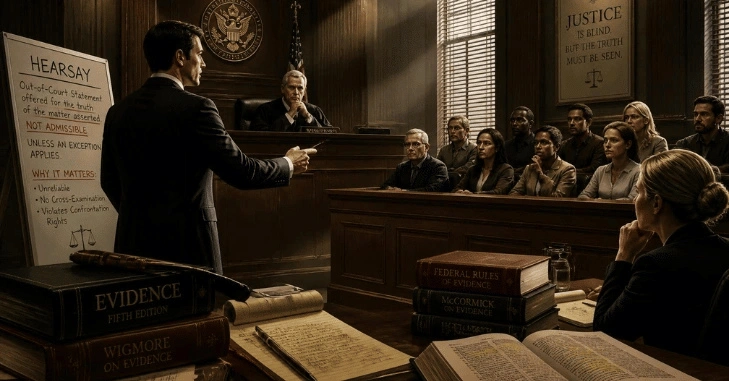
These examples use simplified federal-rule analysis. Actual admissibility can depend on other evidence rules and the specific facts of the case.
| Example | Why the statement is offered | Possible federal treatment |
| A witness says, “Maya told me the traffic light was red.” | To prove the light was red | Generally covered by the exclusion rule unless another provision applies |
| The same statement is offered to prove that a driver received a warning. | To show notice or its effect on the listener | May fall outside the definition because the truth of the statement is not the point |
| A person cries, “The blue car ran the light!” moments after a frightening crash. | To prove what happened | May qualify as an excited utterance if Rule 803 requirements are met |
| A company introduces a routinely created business record. | To prove information recorded during regular operations | May qualify under the business-record exception if its conditions are established |
| A plaintiff offers the defendant’s own relevant statement against the defendant. | To prove what the opposing party said | Certain opposing-party statements are defined outside the category under Rule 801(d)(2). |
Rules 801 and 803 explain these distinctions. They do not make every statement in these categories automatically admissible. Other requirements may still apply.
After a collision, preserving the source of information can make later analysis of evidence easier. WatchingHub also covers the steps for documenting a car accident with an attorney.
Common Federal Exceptions You Should Know
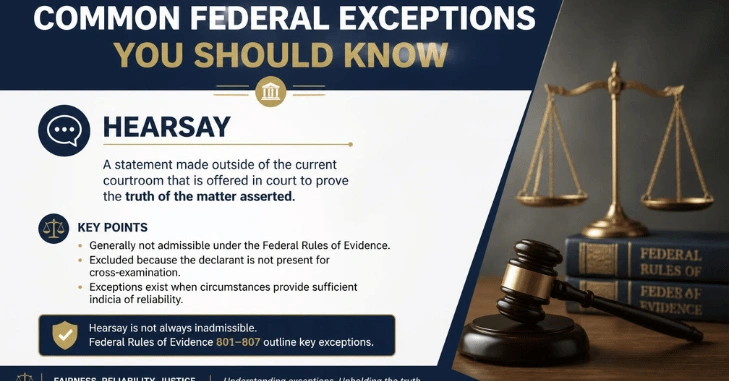
Rule 803 permits several categories of statements even when the person who made the statement is available to testify. Rule 804 contains separate exceptions that depend on the declarant being unavailable.
| Federal provision | Examples it can cover |
| Present-sense impression | A qualifying description made while or immediately after perceiving an event |
| Excited utterance | A qualifying statement concerning a startling event made while the speaker remains under the stress of the event |
| Non-existing condition | Certain statements about a person’s current state of mind, emotion, sensation, or physical condition |
| Medical diagnosis or treatment | Qualifying statements made for, and reasonably related to, medical diagnosis or treatment |
| Regularly conducted activity | Business or organizational records that satisfy the rule’s foundation and trustworthiness requirements |
| Former testimony | Certain earlier testimony when the declarant is unavailable, and the requirements of Rule 804 are met. |
| Statement against interest | Certain statements sufficiently contrary to the interests of an unavailable speaker |
Medical records can raise several evidence questions at once. Readers interested in that setting can also see WatchingHub’s discussion of medical-malpractice cases and supporting evidence.
Rule 801(d): Exclusions vs. Exceptions
One distinction causes frequent confusion. Some statements are admissible because the Federal Rules define them as falling outside the hearsay category. They differ from statements admitted under an exception.
Rule 801(d), for example, covers certain prior statements made by a testifying declarant and certain statements offered against an opposing party. Rules 803 and 804, by contrast, contain exceptions to the general exclusion rule.
What Happens When One Statement Contains Another?
A statement can contain a second out-of-court statement. Imagine a witness testifying, “Ana told me that Ben said the store was closed.”
If the statement is offered to prove that the store was closed, there are two separate layers to analyze. Federal Rule 805 requires each part of the combined statement to have its own valid basis under the evidence rules. A valid exception for one layer does not automatically make the other layer admissible.
Your Next Step
If a real dispute involves an out-of-court statement, preserve the original message, recording, document, or other source when lawful. Hearsay: Identify who made each statement and why the evidence matters.
Then ask a licensed attorney in the relevant jurisdiction how the applicable evidence rules affect your case. For more legal explainers and related topics, browse WatchingHub’s Law section. This article provides general educational information and is not legal advice.
Frequently Asked Questions
No. The federal rules contain both exclusions and exceptions. A federal statute or another applicable rule may also provide a basis for admission. The exact result depends on the statement, its purpose, and the rules that apply in the relevant court.
No. First, ask why the statement is being offered. If it is relevant because the words were spoken rather than because the words were true, the Rule 801 definition may not apply.
No. A text message must still be analyzed based on who made the statement, why it is being offered, and which evidence rules apply. Authentication and other admissibility requirements may create separate issues.
No. The Federal Rules of Evidence govern most proceedings in U.S. federal courts. State courts operate under their own evidence rules, so the analysis can differ by jurisdiction.